
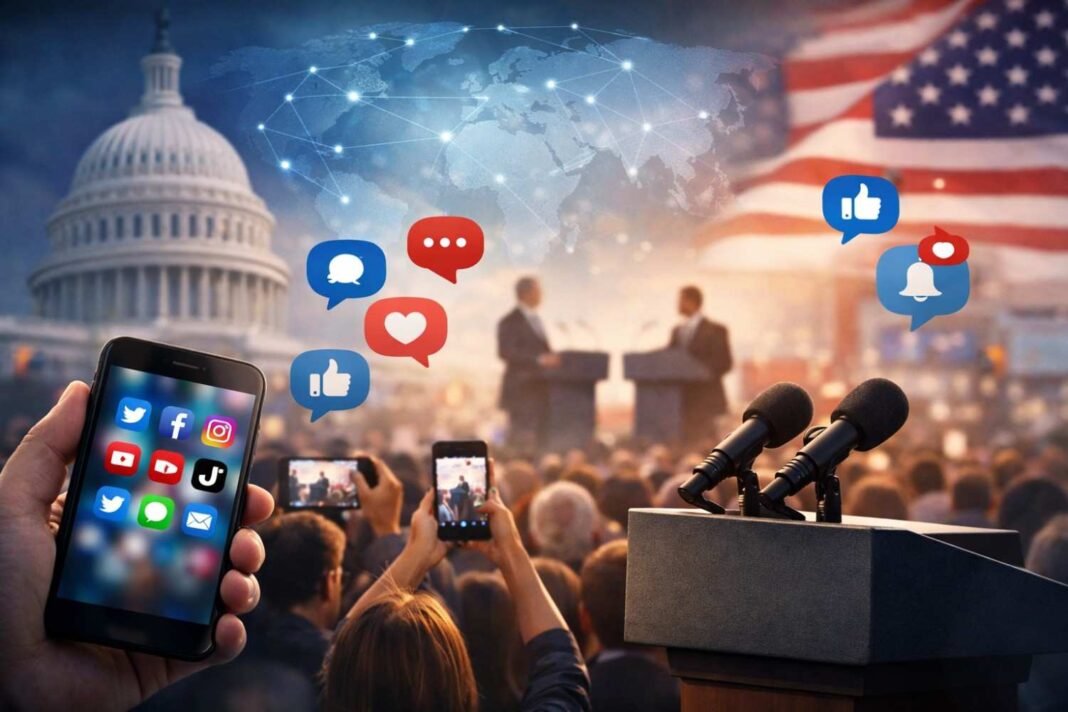

In the past, political discourse was largely shaped by newspapers, television debates, and formal speeches. Today, social media platforms have become the primary arenas where political ideas are shared, debated, challenged, and amplified. From viral hashtags to real-time reactions during elections, social media is fundamentally transforming how citizens engage with politics—and with each other.
Understanding how social media is reshaping political discourse is essential in an era where public opinion can shift in minutes, and a single post can influence millions.
The Rise of Social Media as a Political Powerhouse
Social media has democratized political participation. Platforms such as Twitter (X), Facebook, Instagram, TikTok, and YouTube allow politicians, activists, journalists, and everyday users to communicate directly—without traditional media gatekeepers.
This shift has lowered barriers to entry in political conversations. Individuals who were once excluded from mainstream political platforms can now voice opinions, mobilize supporters, and challenge dominant narratives with unprecedented reach.
As a result, political discourse has become faster, louder, and more participatory than ever before.
Real-Time Political Engagement and Instant Reactions
One of the most significant ways social media is reshaping political discourse is through real-time engagement. Instant public reactions now accompany political debates, elections, protests, and policy announcements.
Live-tweeting debates, trending hashtags, and viral video clips shape how events are interpreted—often before full context is available. While this immediacy increases engagement, it can also oversimplify complex issues and encourage emotional rather than analytical responses.
However, real-time engagement has made politics more approachable, particularly for younger viewers who mostly use social media for news.
Algorithms’ Influence on Political Storytelling
Social media algorithms heavily influence users’ exposure to political content. These algorithms prioritize engagement—likes, shares, comments—which can amplify emotionally charged or polarizing content.
As a result, users are often exposed to viewpoints that reinforce existing beliefs, creating echo chambers. This phenomenon can intensify political polarization, making constructive dialogue more difficult.
At the same time, algorithms can elevate marginalized voices and grassroots movements that traditional media might overlook, demonstrating the dual impact of algorithm-driven discourse.
Social Media and Political Polarization
Political polarization has become one of the most discussed consequences of social media’s influence. Short-form content, character limits, and visual-driven posts often reduce nuanced political issues into slogans or sound bites.
This environment rewards outrage and certainty over compromise and complexity. Opposing viewpoints are frequently framed as enemies rather than differences of opinion, reshaping political discourse into a more confrontational space.
However, polarization is not solely caused by social media—it reflects broader societal divisions that platforms tend to magnify rather than create.
Misinformation, Disinformation, and Trust Challenges
Another critical way social media is reshaping political discourse is through the rapid spread of misinformation and disinformation. False or misleading political content can circulate widely before fact-checkers or authorities respond.
This challenges public trust in institutions, media, and even democratic processes. Deepfakes, manipulated images, and out-of-context videos further complicate the information landscape.
In response, platforms have introduced content moderation policies, fact-checking labels, and transparency measures, though debates continue over censorship, free speech, and platform accountability.
Social Media as a Tool for Political Mobilization
Despite its challenges, social media has proven to be a powerful tool for political mobilization. Online campaigns can quickly translate into offline action, including protests, fundraising, voter registration, and awareness movements.
Hashtags and viral campaigns have played key roles in shaping political agendas worldwide, demonstrating how digital discourse can drive real-world change. Social media enables movements to scale rapidly, cross borders, and maintain momentum.
This participatory model has reshaped political discourse from passive consumption to active involvement.
The Impact on Political Leaders and Institutions
Political leaders now operate in an environment of constant visibility. A single post can define a news cycle, while a misstep can spark widespread backlash.
As a result, political communication has become more informal, personalized, and direct. While this can humanize leaders and increase transparency, it can also blur the line between governance and performance.
Institutions, too, are adapting—using social media to communicate policies, respond to criticism, and engage citizens directly.
The Future of Political Discourse in the Social Media Age
Social media’s influence on political discourse will change as it does. Artificial intelligence, virtual reality, and decentralized platforms are examples of emerging technology that could further shift the exchange and discussion of political ideas.
The challenge moving forward is finding balance—leveraging social media’s ability to engage and empower while mitigating its risks to truth, civility, and democratic dialogue.
Ultimately, how social media reshapes political discourse depends not only on platforms and algorithms, but on how users choose to participate.
Conclusion
Social media has irreversibly changed the nature of political discourse. It has expanded access, accelerated conversations, and amplified once-unheard voices. At the same time, it has introduced new challenges related to polarization, misinformation, and trust.
Understanding how social media is reshaping political discourse is essential for citizens, policymakers, and platforms alike. As digital spaces continue to influence political life, the responsibility for meaningful, informed, and respectful dialogue rests with all participants.